Professional woman wearing an EEG headset stands against a vibrant digital design backdrop featuring colorful interface elements, UX wireframes, analytics dashboards, and flowing simulated brainwave visualizations. The image illustrates neuroscience-powered design optimization, user experience research, and the measurement of cognitive and emotional responses during digital interactions.

Real-Time Neurofeedback for Design Optimization

H.B. Duran

更新於

2026年5月19日

Professional woman wearing an EEG headset stands against a vibrant digital design backdrop featuring colorful interface elements, UX wireframes, analytics dashboards, and flowing simulated brainwave visualizations. The image illustrates neuroscience-powered design optimization, user experience research, and the measurement of cognitive and emotional responses during digital interactions.

Real-Time Neurofeedback for Design Optimization

H.B. Duran

更新於

2026年5月19日

Professional woman wearing an EEG headset stands against a vibrant digital design backdrop featuring colorful interface elements, UX wireframes, analytics dashboards, and flowing simulated brainwave visualizations. The image illustrates neuroscience-powered design optimization, user experience research, and the measurement of cognitive and emotional responses during digital interactions.

Real-Time Neurofeedback for Design Optimization

H.B. Duran

更新於

2026年5月19日

Real-Time Neurofeedback for Design Optimization

Design optimization increasingly depends on real-time measurement rather than delayed feedback cycles. Organizations building digital products, interfaces, campaigns, and customer journeys now use neuroanalytics, behavioral testing, and EEG-driven feedback systems to identify attention patterns, cognitive friction, and emotional response during interaction itself.

This shift toward real-time neurofeedback supports faster iteration cycles, improved product design testing methods, and more evidence-based optimized process design workflows. Rather than waiting for conversion declines, customer complaints, or usability reports, teams can identify friction while users are actively experiencing a product.

For UX leaders, product teams, and digital marketers, the question is no longer whether a design performs. It is understanding why it performs, where attention breaks down, and how users cognitively respond throughout the experience.

Why Real-Time Feedback Matters

Traditional design review processes often rely on retrospective surveys, interviews, session recordings, or delayed analytics. While these methods provide valuable context, they frequently miss subconscious engagement patterns that occur during interaction itself.

Consider how Netflix evaluates viewer retention. The company closely analyzes exactly where audiences stop watching content, rewind scenes, or abandon a title. Those behavioral signals help identify moments where engagement changes. Real-time neurofeedback extends this concept by measuring audience response as those moments occur rather than only observing behavior afterward.

Similarly, Spotify uses extensive behavioral data to understand listener engagement and recommendation quality. Yet behavioral data alone cannot fully explain emotional response, attention sustainability, or cognitive stress while users interact with an experience.

Real-time neurofeedback helps bridge that gap by measuring attention shifts, stress response, engagement patterns, mental fatigue, and interaction friction during the experience itself.

Optimized Process Design Through Neuroanalytics

Optimized process design focuses on reducing friction while improving engagement, usability, and decision clarity.

Many of the world's largest digital platforms invest heavily in understanding user behavior during critical moments. Amazon, for example, continuously refines its checkout process because even small reductions in friction can significantly affect conversion rates. Shopify similarly publishes extensive research around simplifying ecommerce workflows and reducing unnecessary decision-making.

The challenge is that traditional analytics often reveal where users leave but not necessarily why.

Neuroanalytics provides another layer of insight by measuring cognitive and emotional response during interaction. Researchers may identify stress spikes during onboarding, attention decline during product comparison, or cognitive overload when users encounter too many choices simultaneously.

These insights help teams refine experiences before deployment rather than reacting to performance problems after launch.

How EEG Supports Design Optimization

EEG-based neuroanalytics measures electrical brain activity associated with attention, engagement, cognitive effort, and emotional processing.

Modern systems translate this data into interpretable metrics that help organizations evaluate user experience quality in real time. Instead of relying exclusively on subjective feedback, teams gain measurable insight into how users respond during interaction.

This is particularly useful when testing experiences where users may struggle to articulate what feels confusing or frustrating.

Research published by Nielsen Norman Group has repeatedly demonstrated that users often experience friction they cannot clearly explain during post-session interviews. Measuring cognitive response during interaction can reveal these moments more directly.

Organizations increasingly use EEG-based audience research to evaluate attention sustainability, cognitive stress, emotional engagement, response to interface changes, and overall interaction quality.

Real-Time Testing for Product Design

Product design testing methods increasingly combine behavioral analytics, usability research, and neurofeedback to evaluate complex interactions.

Companies such as Google, Microsoft, and Adobe invest heavily in usability testing because small interface improvements can have outsized effects across millions of users. While traditional UX testing identifies many usability issues, neurofeedback can help uncover hidden engagement challenges that behavioral metrics alone may not reveal.

Researchers may evaluate SaaS dashboards, ecommerce journeys, onboarding workflows, mobile applications, content platforms, and conversion funnels.

For example, a dashboard may appear logically organized from a design perspective while still generating elevated cognitive stress during task completion. A mobile checkout flow may technically function correctly while producing subconscious hesitation during key decision points.

Understanding these moments helps teams move beyond assumptions and identify optimization opportunities more precisely.

Reducing Cognitive Stress

One of the primary goals of modern UX design is reducing unnecessary cognitive stress.

Research from Nielsen Norman Group on cognitive load consistently shows that users perform better when interfaces reduce mental effort and simplify decision-making. When experiences become overly complex, users often disengage regardless of product quality.

Common sources of cognitive stress include dense interfaces, unclear hierarchy, excessive decision points, interruptive UI patterns, weak navigation systems, and inconsistent workflows.

Apple provides a useful example of minimizing cognitive stress through simplicity. Its product pages emphasize visual clarity, limited choices, and strong hierarchy, helping users process information without becoming overwhelmed.

Neurofeedback helps researchers detect moments where mental effort increases unexpectedly, allowing teams to refine experiences before those issues affect performance at scale.

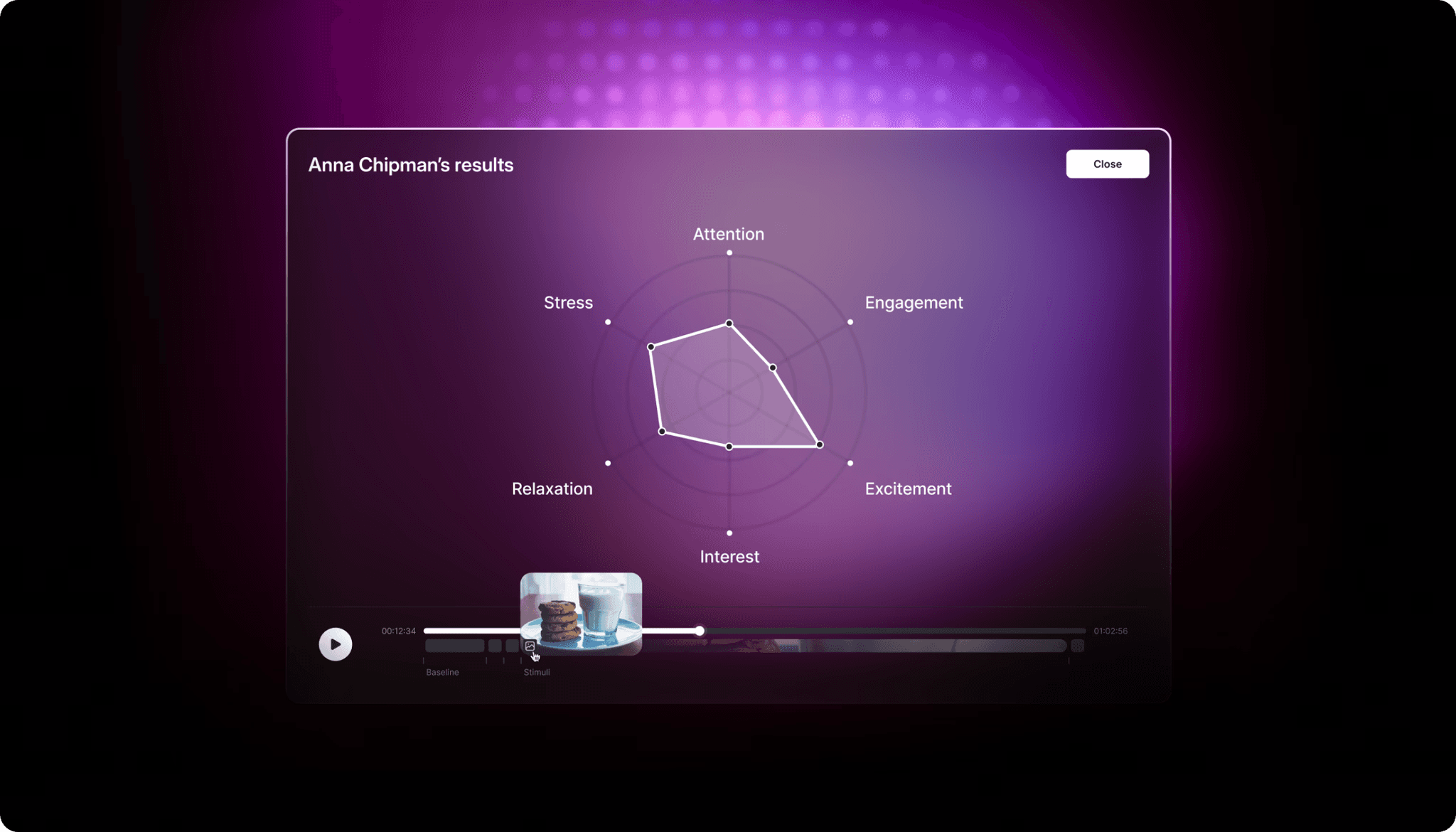
Above: A brand experience is paired in real-time with a testing participant's cognitive states inside Emotiv Studio to detect moment-by-moment design analysis.

Moment-by-Moment Design Analysis

One of the most valuable aspects of neuroanalytics is the ability to evaluate experiences moment by moment.

Emotiv Studio aligns brain responses to specific moments within content, workflows, or interface interactions and converts those signals into interpretable metrics.

This allows teams to identify:

  • Attention drops

  • Stress spikes

  • Emotional peaks

  • Engagement decline

  • Moments of confusion

Rather than treating UX as a static experience, organizations can observe how cognition changes continuously throughout an interaction.

This approach mirrors how modern video analytics platforms evaluate audience retention over time. Instead of viewing an experience as a single outcome, teams can understand where engagement changes and why.

Real-Time Neurofeedback in Creative Optimization

Real-time neurofeedback extends beyond product design into creative performance analysis.

Major streaming platforms, advertisers, and media companies increasingly study audience retention, attention, and emotional engagement to improve content effectiveness.

For example, YouTube creators often analyze audience-retention graphs to understand where viewers disengage. Marketing teams review video completion rates and CTA performance to identify optimization opportunities.

However, these metrics reveal outcomes rather than underlying emotional response.

Neurofeedback adds another dimension by measuring engagement, attention sustainability, emotional pacing, and message clarity while audiences experience content.

This helps organizations refine advertising, branded content, landing pages, and video experiences before launch, reducing wasted media spend and improving creative performance.

Supporting Faster Iteration Cycles

One of the strongest advantages of real-time neurofeedback is speed.

Traditional research cycles may require weeks of data collection, analysis, reporting, and implementation before insights emerge.

Modern neuroanalytics platforms increasingly support AI-assisted analysis, automated summaries, and rapid engagement reporting. Teams can often identify meaningful patterns within minutes rather than weeks.

This creates opportunities for faster test-refine workflows across product, UX, and creative teams.

In environments where digital experiences evolve continuously, faster learning cycles create significant competitive advantages.

Why Neuromarketing Techniques Are Becoming More Important

Organizations increasingly recognize that attention, engagement, and decision-making are not fully explained by clicks, conversions, or survey responses alone.

Behavioral analytics reveal what users did. Neuromarketing techniques help reveal how users experienced the journey leading to those outcomes.

By measuring cognitive states during interaction, teams gain insight into attention sustainability, emotional engagement, cognitive stress, decision confidence, and friction points that may otherwise remain invisible.

This deeper understanding supports more evidence-based design decisions and stronger optimization outcomes across digital products and customer experiences.

Applying Real-Time Neurofeedback to Next-Generation Design Research

Real-time neurofeedback is changing how organizations approach design optimization, creative analysis, and product testing.

By combining EEG-based neuroanalytics, behavioral analytics, usability research, and AI-supported insight workflows, teams can better understand attention, emotional engagement, cognitive stress, and user friction as experiences unfold.

This supports faster iteration cycles, more evidence-based decision-making, and stronger optimized process design strategies across digital products, ecommerce environments, SaaS platforms, and customer journeys.

Organizations that understand audience response earlier in the design process gain a significant advantage. Rather than relying solely on assumptions or post-launch analytics, they can evaluate cognitive and emotional performance while experiences are being built.

Conclusion

Real-time neurofeedback is transforming how organizations evaluate digital experiences, creative assets, and product workflows.

Brands such as Amazon, Apple, Netflix, Spotify, Google, and Microsoft have demonstrated the value of understanding user behavior at increasingly granular levels. The next evolution is measuring cognitive and emotional response alongside behavioral outcomes.

By combining EEG-based neuroanalytics, behavioral analytics, and AI-supported research workflows, teams can better understand attention, cognitive stress, emotional engagement, and user friction during interaction itself.

Learn more about how neuroscience fills the gaps left by traditional user and product research methods.

Real-Time Neurofeedback for Design Optimization

Design optimization increasingly depends on real-time measurement rather than delayed feedback cycles. Organizations building digital products, interfaces, campaigns, and customer journeys now use neuroanalytics, behavioral testing, and EEG-driven feedback systems to identify attention patterns, cognitive friction, and emotional response during interaction itself.

This shift toward real-time neurofeedback supports faster iteration cycles, improved product design testing methods, and more evidence-based optimized process design workflows. Rather than waiting for conversion declines, customer complaints, or usability reports, teams can identify friction while users are actively experiencing a product.

For UX leaders, product teams, and digital marketers, the question is no longer whether a design performs. It is understanding why it performs, where attention breaks down, and how users cognitively respond throughout the experience.

Why Real-Time Feedback Matters

Traditional design review processes often rely on retrospective surveys, interviews, session recordings, or delayed analytics. While these methods provide valuable context, they frequently miss subconscious engagement patterns that occur during interaction itself.

Consider how Netflix evaluates viewer retention. The company closely analyzes exactly where audiences stop watching content, rewind scenes, or abandon a title. Those behavioral signals help identify moments where engagement changes. Real-time neurofeedback extends this concept by measuring audience response as those moments occur rather than only observing behavior afterward.

Similarly, Spotify uses extensive behavioral data to understand listener engagement and recommendation quality. Yet behavioral data alone cannot fully explain emotional response, attention sustainability, or cognitive stress while users interact with an experience.

Real-time neurofeedback helps bridge that gap by measuring attention shifts, stress response, engagement patterns, mental fatigue, and interaction friction during the experience itself.

Optimized Process Design Through Neuroanalytics

Optimized process design focuses on reducing friction while improving engagement, usability, and decision clarity.

Many of the world's largest digital platforms invest heavily in understanding user behavior during critical moments. Amazon, for example, continuously refines its checkout process because even small reductions in friction can significantly affect conversion rates. Shopify similarly publishes extensive research around simplifying ecommerce workflows and reducing unnecessary decision-making.

The challenge is that traditional analytics often reveal where users leave but not necessarily why.

Neuroanalytics provides another layer of insight by measuring cognitive and emotional response during interaction. Researchers may identify stress spikes during onboarding, attention decline during product comparison, or cognitive overload when users encounter too many choices simultaneously.

These insights help teams refine experiences before deployment rather than reacting to performance problems after launch.

How EEG Supports Design Optimization

EEG-based neuroanalytics measures electrical brain activity associated with attention, engagement, cognitive effort, and emotional processing.

Modern systems translate this data into interpretable metrics that help organizations evaluate user experience quality in real time. Instead of relying exclusively on subjective feedback, teams gain measurable insight into how users respond during interaction.

This is particularly useful when testing experiences where users may struggle to articulate what feels confusing or frustrating.

Research published by Nielsen Norman Group has repeatedly demonstrated that users often experience friction they cannot clearly explain during post-session interviews. Measuring cognitive response during interaction can reveal these moments more directly.

Organizations increasingly use EEG-based audience research to evaluate attention sustainability, cognitive stress, emotional engagement, response to interface changes, and overall interaction quality.

Real-Time Testing for Product Design

Product design testing methods increasingly combine behavioral analytics, usability research, and neurofeedback to evaluate complex interactions.

Companies such as Google, Microsoft, and Adobe invest heavily in usability testing because small interface improvements can have outsized effects across millions of users. While traditional UX testing identifies many usability issues, neurofeedback can help uncover hidden engagement challenges that behavioral metrics alone may not reveal.

Researchers may evaluate SaaS dashboards, ecommerce journeys, onboarding workflows, mobile applications, content platforms, and conversion funnels.

For example, a dashboard may appear logically organized from a design perspective while still generating elevated cognitive stress during task completion. A mobile checkout flow may technically function correctly while producing subconscious hesitation during key decision points.

Understanding these moments helps teams move beyond assumptions and identify optimization opportunities more precisely.

Reducing Cognitive Stress

One of the primary goals of modern UX design is reducing unnecessary cognitive stress.

Research from Nielsen Norman Group on cognitive load consistently shows that users perform better when interfaces reduce mental effort and simplify decision-making. When experiences become overly complex, users often disengage regardless of product quality.

Common sources of cognitive stress include dense interfaces, unclear hierarchy, excessive decision points, interruptive UI patterns, weak navigation systems, and inconsistent workflows.

Apple provides a useful example of minimizing cognitive stress through simplicity. Its product pages emphasize visual clarity, limited choices, and strong hierarchy, helping users process information without becoming overwhelmed.

Neurofeedback helps researchers detect moments where mental effort increases unexpectedly, allowing teams to refine experiences before those issues affect performance at scale.

Above: A brand experience is paired in real-time with a testing participant's cognitive states inside Emotiv Studio to detect moment-by-moment design analysis.

Moment-by-Moment Design Analysis

One of the most valuable aspects of neuroanalytics is the ability to evaluate experiences moment by moment.

Emotiv Studio aligns brain responses to specific moments within content, workflows, or interface interactions and converts those signals into interpretable metrics.

This allows teams to identify:

  • Attention drops

  • Stress spikes

  • Emotional peaks

  • Engagement decline

  • Moments of confusion

Rather than treating UX as a static experience, organizations can observe how cognition changes continuously throughout an interaction.

This approach mirrors how modern video analytics platforms evaluate audience retention over time. Instead of viewing an experience as a single outcome, teams can understand where engagement changes and why.

Real-Time Neurofeedback in Creative Optimization

Real-time neurofeedback extends beyond product design into creative performance analysis.

Major streaming platforms, advertisers, and media companies increasingly study audience retention, attention, and emotional engagement to improve content effectiveness.

For example, YouTube creators often analyze audience-retention graphs to understand where viewers disengage. Marketing teams review video completion rates and CTA performance to identify optimization opportunities.

However, these metrics reveal outcomes rather than underlying emotional response.

Neurofeedback adds another dimension by measuring engagement, attention sustainability, emotional pacing, and message clarity while audiences experience content.

This helps organizations refine advertising, branded content, landing pages, and video experiences before launch, reducing wasted media spend and improving creative performance.

Supporting Faster Iteration Cycles

One of the strongest advantages of real-time neurofeedback is speed.

Traditional research cycles may require weeks of data collection, analysis, reporting, and implementation before insights emerge.

Modern neuroanalytics platforms increasingly support AI-assisted analysis, automated summaries, and rapid engagement reporting. Teams can often identify meaningful patterns within minutes rather than weeks.

This creates opportunities for faster test-refine workflows across product, UX, and creative teams.

In environments where digital experiences evolve continuously, faster learning cycles create significant competitive advantages.

Why Neuromarketing Techniques Are Becoming More Important

Organizations increasingly recognize that attention, engagement, and decision-making are not fully explained by clicks, conversions, or survey responses alone.

Behavioral analytics reveal what users did. Neuromarketing techniques help reveal how users experienced the journey leading to those outcomes.

By measuring cognitive states during interaction, teams gain insight into attention sustainability, emotional engagement, cognitive stress, decision confidence, and friction points that may otherwise remain invisible.

This deeper understanding supports more evidence-based design decisions and stronger optimization outcomes across digital products and customer experiences.

Applying Real-Time Neurofeedback to Next-Generation Design Research

Real-time neurofeedback is changing how organizations approach design optimization, creative analysis, and product testing.

By combining EEG-based neuroanalytics, behavioral analytics, usability research, and AI-supported insight workflows, teams can better understand attention, emotional engagement, cognitive stress, and user friction as experiences unfold.

This supports faster iteration cycles, more evidence-based decision-making, and stronger optimized process design strategies across digital products, ecommerce environments, SaaS platforms, and customer journeys.

Organizations that understand audience response earlier in the design process gain a significant advantage. Rather than relying solely on assumptions or post-launch analytics, they can evaluate cognitive and emotional performance while experiences are being built.

Conclusion

Real-time neurofeedback is transforming how organizations evaluate digital experiences, creative assets, and product workflows.

Brands such as Amazon, Apple, Netflix, Spotify, Google, and Microsoft have demonstrated the value of understanding user behavior at increasingly granular levels. The next evolution is measuring cognitive and emotional response alongside behavioral outcomes.

By combining EEG-based neuroanalytics, behavioral analytics, and AI-supported research workflows, teams can better understand attention, cognitive stress, emotional engagement, and user friction during interaction itself.

Learn more about how neuroscience fills the gaps left by traditional user and product research methods.

Real-Time Neurofeedback for Design Optimization

Design optimization increasingly depends on real-time measurement rather than delayed feedback cycles. Organizations building digital products, interfaces, campaigns, and customer journeys now use neuroanalytics, behavioral testing, and EEG-driven feedback systems to identify attention patterns, cognitive friction, and emotional response during interaction itself.

This shift toward real-time neurofeedback supports faster iteration cycles, improved product design testing methods, and more evidence-based optimized process design workflows. Rather than waiting for conversion declines, customer complaints, or usability reports, teams can identify friction while users are actively experiencing a product.

For UX leaders, product teams, and digital marketers, the question is no longer whether a design performs. It is understanding why it performs, where attention breaks down, and how users cognitively respond throughout the experience.

Why Real-Time Feedback Matters

Traditional design review processes often rely on retrospective surveys, interviews, session recordings, or delayed analytics. While these methods provide valuable context, they frequently miss subconscious engagement patterns that occur during interaction itself.

Consider how Netflix evaluates viewer retention. The company closely analyzes exactly where audiences stop watching content, rewind scenes, or abandon a title. Those behavioral signals help identify moments where engagement changes. Real-time neurofeedback extends this concept by measuring audience response as those moments occur rather than only observing behavior afterward.

Similarly, Spotify uses extensive behavioral data to understand listener engagement and recommendation quality. Yet behavioral data alone cannot fully explain emotional response, attention sustainability, or cognitive stress while users interact with an experience.

Real-time neurofeedback helps bridge that gap by measuring attention shifts, stress response, engagement patterns, mental fatigue, and interaction friction during the experience itself.

Optimized Process Design Through Neuroanalytics

Optimized process design focuses on reducing friction while improving engagement, usability, and decision clarity.

Many of the world's largest digital platforms invest heavily in understanding user behavior during critical moments. Amazon, for example, continuously refines its checkout process because even small reductions in friction can significantly affect conversion rates. Shopify similarly publishes extensive research around simplifying ecommerce workflows and reducing unnecessary decision-making.

The challenge is that traditional analytics often reveal where users leave but not necessarily why.

Neuroanalytics provides another layer of insight by measuring cognitive and emotional response during interaction. Researchers may identify stress spikes during onboarding, attention decline during product comparison, or cognitive overload when users encounter too many choices simultaneously.

These insights help teams refine experiences before deployment rather than reacting to performance problems after launch.

How EEG Supports Design Optimization

EEG-based neuroanalytics measures electrical brain activity associated with attention, engagement, cognitive effort, and emotional processing.

Modern systems translate this data into interpretable metrics that help organizations evaluate user experience quality in real time. Instead of relying exclusively on subjective feedback, teams gain measurable insight into how users respond during interaction.

This is particularly useful when testing experiences where users may struggle to articulate what feels confusing or frustrating.

Research published by Nielsen Norman Group has repeatedly demonstrated that users often experience friction they cannot clearly explain during post-session interviews. Measuring cognitive response during interaction can reveal these moments more directly.

Organizations increasingly use EEG-based audience research to evaluate attention sustainability, cognitive stress, emotional engagement, response to interface changes, and overall interaction quality.

Real-Time Testing for Product Design

Product design testing methods increasingly combine behavioral analytics, usability research, and neurofeedback to evaluate complex interactions.

Companies such as Google, Microsoft, and Adobe invest heavily in usability testing because small interface improvements can have outsized effects across millions of users. While traditional UX testing identifies many usability issues, neurofeedback can help uncover hidden engagement challenges that behavioral metrics alone may not reveal.

Researchers may evaluate SaaS dashboards, ecommerce journeys, onboarding workflows, mobile applications, content platforms, and conversion funnels.

For example, a dashboard may appear logically organized from a design perspective while still generating elevated cognitive stress during task completion. A mobile checkout flow may technically function correctly while producing subconscious hesitation during key decision points.

Understanding these moments helps teams move beyond assumptions and identify optimization opportunities more precisely.

Reducing Cognitive Stress

One of the primary goals of modern UX design is reducing unnecessary cognitive stress.

Research from Nielsen Norman Group on cognitive load consistently shows that users perform better when interfaces reduce mental effort and simplify decision-making. When experiences become overly complex, users often disengage regardless of product quality.

Common sources of cognitive stress include dense interfaces, unclear hierarchy, excessive decision points, interruptive UI patterns, weak navigation systems, and inconsistent workflows.

Apple provides a useful example of minimizing cognitive stress through simplicity. Its product pages emphasize visual clarity, limited choices, and strong hierarchy, helping users process information without becoming overwhelmed.

Neurofeedback helps researchers detect moments where mental effort increases unexpectedly, allowing teams to refine experiences before those issues affect performance at scale.

Above: A brand experience is paired in real-time with a testing participant's cognitive states inside Emotiv Studio to detect moment-by-moment design analysis.

Moment-by-Moment Design Analysis

One of the most valuable aspects of neuroanalytics is the ability to evaluate experiences moment by moment.

Emotiv Studio aligns brain responses to specific moments within content, workflows, or interface interactions and converts those signals into interpretable metrics.

This allows teams to identify:

  • Attention drops

  • Stress spikes

  • Emotional peaks

  • Engagement decline

  • Moments of confusion

Rather than treating UX as a static experience, organizations can observe how cognition changes continuously throughout an interaction.

This approach mirrors how modern video analytics platforms evaluate audience retention over time. Instead of viewing an experience as a single outcome, teams can understand where engagement changes and why.

Real-Time Neurofeedback in Creative Optimization

Real-time neurofeedback extends beyond product design into creative performance analysis.

Major streaming platforms, advertisers, and media companies increasingly study audience retention, attention, and emotional engagement to improve content effectiveness.

For example, YouTube creators often analyze audience-retention graphs to understand where viewers disengage. Marketing teams review video completion rates and CTA performance to identify optimization opportunities.

However, these metrics reveal outcomes rather than underlying emotional response.

Neurofeedback adds another dimension by measuring engagement, attention sustainability, emotional pacing, and message clarity while audiences experience content.

This helps organizations refine advertising, branded content, landing pages, and video experiences before launch, reducing wasted media spend and improving creative performance.

Supporting Faster Iteration Cycles

One of the strongest advantages of real-time neurofeedback is speed.

Traditional research cycles may require weeks of data collection, analysis, reporting, and implementation before insights emerge.

Modern neuroanalytics platforms increasingly support AI-assisted analysis, automated summaries, and rapid engagement reporting. Teams can often identify meaningful patterns within minutes rather than weeks.

This creates opportunities for faster test-refine workflows across product, UX, and creative teams.

In environments where digital experiences evolve continuously, faster learning cycles create significant competitive advantages.

Why Neuromarketing Techniques Are Becoming More Important

Organizations increasingly recognize that attention, engagement, and decision-making are not fully explained by clicks, conversions, or survey responses alone.

Behavioral analytics reveal what users did. Neuromarketing techniques help reveal how users experienced the journey leading to those outcomes.

By measuring cognitive states during interaction, teams gain insight into attention sustainability, emotional engagement, cognitive stress, decision confidence, and friction points that may otherwise remain invisible.

This deeper understanding supports more evidence-based design decisions and stronger optimization outcomes across digital products and customer experiences.

Applying Real-Time Neurofeedback to Next-Generation Design Research

Real-time neurofeedback is changing how organizations approach design optimization, creative analysis, and product testing.

By combining EEG-based neuroanalytics, behavioral analytics, usability research, and AI-supported insight workflows, teams can better understand attention, emotional engagement, cognitive stress, and user friction as experiences unfold.

This supports faster iteration cycles, more evidence-based decision-making, and stronger optimized process design strategies across digital products, ecommerce environments, SaaS platforms, and customer journeys.

Organizations that understand audience response earlier in the design process gain a significant advantage. Rather than relying solely on assumptions or post-launch analytics, they can evaluate cognitive and emotional performance while experiences are being built.

Conclusion

Real-time neurofeedback is transforming how organizations evaluate digital experiences, creative assets, and product workflows.

Brands such as Amazon, Apple, Netflix, Spotify, Google, and Microsoft have demonstrated the value of understanding user behavior at increasingly granular levels. The next evolution is measuring cognitive and emotional response alongside behavioral outcomes.

By combining EEG-based neuroanalytics, behavioral analytics, and AI-supported research workflows, teams can better understand attention, cognitive stress, emotional engagement, and user friction during interaction itself.

Learn more about how neuroscience fills the gaps left by traditional user and product research methods.

繼續閱讀

6 Best Engagement Analytics Platforms Compared